

Learn how combining affinity-tuned CD3 engagement with HCAb and VH domain technologies enables smarter TCE design, unlocking novel multispecific formats, improved developability, and the potential for safer, more effective therapies.
Enhancing TCE Selectivity: A Critical Goal in Solid Tumors
A major challenge in developing TCEs for solid tumors is the limited repertoire of truly tumor-specific antigens (TSAs). Therefore, researchers have conventionally targeted tumor-associated antigens (TAAs), which may be overexpressed in tumors but are also present at low levels in many healthy tissues.
This approach inevitably carries the risk of on-target/off-tumor toxicities, limiting the therapeutic window of TCEs to varying degrees depending on the targeted tissues and organs.
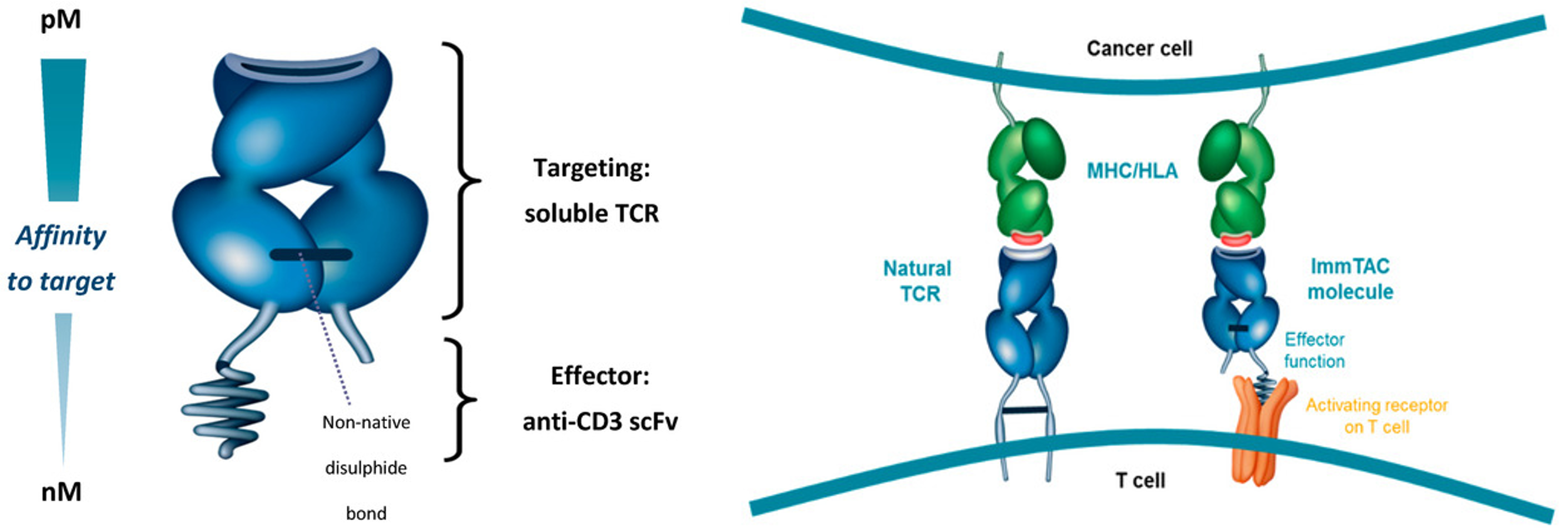
As mentioned previously, only two TCEs have achieved therapeutic success in solid tumors to date. Among these, Tebentafusp is the first of its kind, leveraging an engineered TCR, immune-mobilizing monoclonal T cell receptor against cancer (ImmTAC), to target a specific gp100 peptide-HLA complex displayed by uveal melanoma cells.
ImmTAC molecules and similar TCR mimic binders exploit the expansive, often untapped intracellular antigen space. By leveraging soluble TCR-like molecules with high-affinity binding to peptides presented by HLA complexes, these constructs provide more opportunities to reach peptide sequences that may be more unique to tumor tissues.
Although gp100 expression is not tumor-specific, it is largely confined to melanocytes and to both cutaneous and uveal melanoma. Therefore, the peptide targeted by Tebentafusp is highly lineage-restricted, limiting potential cross-reactivity and on-target toxicities [3].
Similarly, Tarlatamab exploits the neuroendocrine lineage-restricted surface antigen DLL3, which is minimally expressed in most healthy adult tissues but highly expressed in approximately 80-90% of SCLC tumors [5]. Therefore, both TCEs work well because they identify a target that is not completely tumor-specific but is sufficiently lineage restricted to provide meaningful therapeutic selectivity.
Given the limited options for effectively and safely targeting solid tumors, improving tumor selectivity has emerged as a particularly important objective for TCE development.
Conditionally Activated TCEs
To achieve selective activation at tumor sites, researchers are engineering TCEs with structural elements sensitive to the unique conditions of the tumor microenvironment (TME). The incorporation of masking domains, protease-cleavable linkers, and other activation modules has driven a shift away from conventional antibody formats toward more compact, modular architectures that better accommodate these additional structural elements. As a result, most conditional TCEs leverage antibody fragments, scFvs, and single-domain binders, whose reduced size and greater design flexibility enable the assembly of increasingly complex multispecific and activatable molecules [2].
Two of the most advanced conditional TCE strategies rely on (i) protease-cleavable masks that block one or both binding domains until exposed to tumor-associated proteases and (ii) pH-sensitive binding domains that exploit the acidic conditions of the TME.
To date, protease-activated approaches have achieved the greatest clinical traction, with multiple platforms advancing candidates into human studies. Among these, VIR-5818, a masked HER2×CD3 TCE utilizing the PRO-XTEN® platform, has progressed to Phase 2 evaluation in patients with HER2-positive solid tumors.

While masked TCEs are meant to improve safety by restricting activity to the TME, a main drawback is that their performance depends on reliable tumor-specific activation. Heterogeneity in protease expression across patients, tumor types, and individual lesions may therefore result in incomplete activation and variable antitumor activity.
In addition, from a development standpoint, protease-activated T-cell engagers are more complex, requiring carefully optimized binding-domain structure and affinity, cleavable-linker stability, and linker and masking-domain design.
Logic-Gating TCE Activity
To address heterogeneous antigen expression, researchers are developing TCEs with TAA multispecificity and logic-gating. OR-gating enables a single TCE to recognize multiple tumor antigens, allowing tumor cell killing when either target is expressed. This design may enhance efficacy in heterogeneous tumors and mitigate resistance driven by antigen loss. However, the expanded target reach can also increase the risk of on-target, off-tumor toxicity if either antigen is expressed on normal tissues [2].
While several OR-gated TCE candidates are in early-stage clinical evaluation, the majority are designed for hematological malignancies. One exception is the candidate SOA101 from Shine-On Biomedical Co., a nanobody-based trispecific antibody T cell engager targeting PD-L1/HLA-G/CD3. This candidate is currently undergoing Phase1/2a (NCT07055594) evaluation for advanced or metastatic solid tumor treatment, including lung cancer, colorectal cancer, breast cancer, head and neck cancer, and ovarian cancer [7].
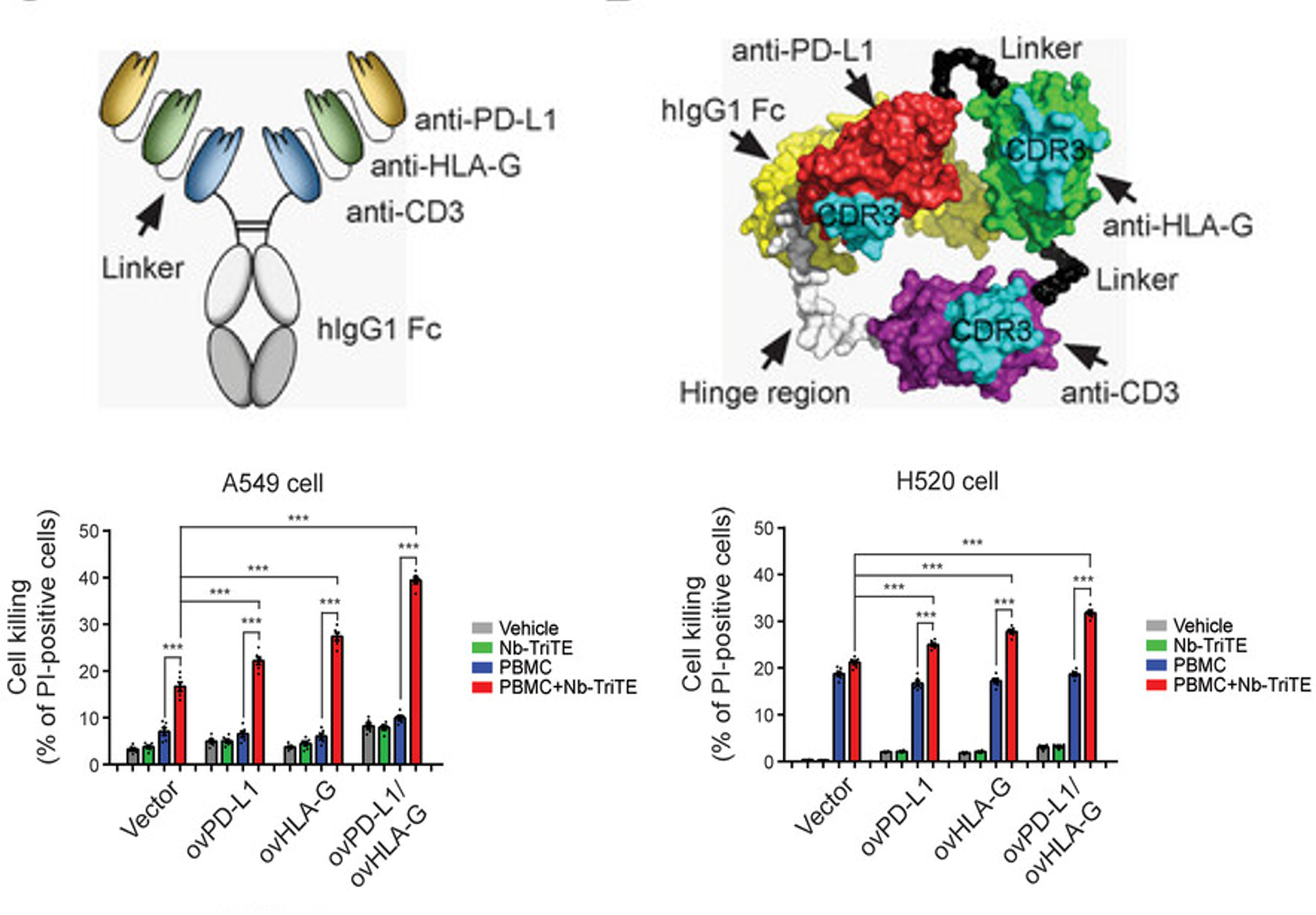
Functional studies demonstrated an OR-gating mechanism, in which T-cell redirection and tumor cell killing occurred against tumor cells overexpressing PD-L1 alone or HLA-G alone, while the strongest cytotoxic activity was observed in cells co-expressing both targets. These findings indicate that recognition of either antigen is sufficient to trigger activity, with dual-antigen expression further enhancing potency, thereby broadening tumor coverage and helping address antigen heterogeneity [8].
Beyond the biological benefits of dual checkpoint targeting, SOA101 highlights the modularity of VHH-based architecture, enabling the incorporation of multiple binding functionalities in a compact format to produce a complex yet manufacturable molecule.
Far fewer AND-gated TCEs have reached the clinical stage, possibly because of their higher design complexity. Among candidates, only one, Amgen’s AMG 305, was being evaluated for solid tumor indications (NCT05800964). The AND-gated TCE AMG 305 was designed as a dual-targeting BiTE® molecule requiring the engagement of CDH3 (P-cadherin) and MSLN (mesothelin) to achieve potent TDCC [9]. While in vitro and in vivo IND-supporting nonclinical data demonstrated the intended mechanism of action and tolerable safety signals, clinical evaluation of AMG 305 did not progress into Phase 2 and has since been terminated.
Like with other next-generation TCE designs, increased complexity also carries drawbacks; AND-gated TCEs may face efficacy limitations due to evolving tumor heterogeneity and patient-to-patient differential expression.
Additionally, AND-gated TCEs are also more challenging to develop because the affinities of each tumor-antigen-binding domain must be carefully fine-tuned. Specifically, affinities must be dialed down to achieve the desired avidity-based activation of TDCC [2]. In this context, discovery platforms that generate diverse binder repertoires and support flexible affinity engineering can help identify binding-domain combinations that achieve the desired balance of selectivity, safety, and efficacy.
Costimulatory TCEs
To address these challenges, researchers are developing costimulatory T-cell engagers designed to provide signal 2 alongside CD3-mediated activation. These next-generation TCEs incorporate agonistic domains targeting costimulatory receptors such as 4-1BB (CD137), CD28, or CD2, with the goal of enhancing T-cell expansion, persistence, cytokine production, and resistance to exhaustion.
By selectively delivering costimulatory signals only when tumor engagement occurs, these approaches seek to improve antitumor efficacy without triggering widespread systemic immune activation [2].
Costimulatory TCEs Designed to Enhance T-Cell Activation and Persistence in Solid Tumors at Clinical Stage

Among the most advanced examples is Clesitamig (RO7616789/RG6524/ALPs12), a trispecific TCE developed by Chugai/Roche for neuroendocrine malignancies and small-cell lung cancer (SCLC). Clesitamig targets the lineage-restricted surface antigen DLL3 on tumor cells while engaging both CD3 and the costimulatory receptor 4-1BB on T cells.
The dual-specificity T-cell binding Fab fragment is engineered to deliver coordinated activation while preventing simultaneous binding of CD3 and CD137, reducing off‑target effects and improving T‑cell activation efficiency [14].
In preclinical studies, incorporation of 4-1BB costimulation enhanced antitumor activity compared with conventional DLL3-targeting T-cell engagers, supporting the concept that coordinated delivery of signal 1 and signal 2 can improve functional T-cell responses in solid tumors [14].
Alternative costimulatory approaches include Sanofi’s SAR443216, which combines CD28-mediated costimulation with HER2 and CD3 targeting for solid tumors, while EvolveImmune Therapeutics’ EVOLVE104 leverages CD2 agonism alongside CD3 engagement. These programs reflect growing interest in identifying the optimal costimulatory pathway to maximize T-cell function, including proliferation, differentiation, and survival, while maintaining an acceptable safety profile [2, 11].
This strategy is not without challenges, as immune costimulation can be associated with severe toxicities, emphasizing the importance of tightly controlling receptor engagement and activation thresholds. Identifying the optimal balance between CD3 activation, costimulatory potency, and tumor targeting therefore requires careful engineering of binding affinities, epitope selection, and molecular geometry. As with other next-generation TCEs, incorporation of multiple functional domains increases molecular complexity and places greater demands on format architecture, developability, and manufacturability.
Enabling Next-Generation Immune Cell Engagers with Fully Human HCAb Technology
As TCE designs become increasingly complex, the underlying discovery and engineering platform becomes a critical consideration. Developers need binders that not only exhibit the desired affinity and epitope properties but can also be readily incorporated into multispecific and activatable formats while maintaining favorable developability and manufacturability.
Nona’s fully human heavy-chain-only antibody (HCAb) platform enables the discovery of naturally occurring VH domains that serve as versatile building blocks for next-generation immune-cell engagers. Combined with its HBICE® bispecific and multispecific engineering platform, these domains can be incorporated into a wide range of immune-cell engager architectures, supporting the development of molecules with enhanced selectivity, optimized immune activation, and improved therapeutic potential.
The combination of HCAb-derived binders and HBICE® engineering provides several advantages relevant to next-generation TCE development:
- Access to highly diverse fully human VH repertoires for challenging and novel targets
- Flexible affinity optimization to balance potency, selectivity, cytokine release, and safety
- Efficient generation of bi-, tri-, and multispecific immune-cell engager formats
- Simplified incorporation of multiple targeting and immune-modulating functionalities
- Broad epitope coverage for difficult-to-drug targets
- Reduced immunogenicity risk through fully human sequences
- Compact, highly developable architectures that support manufacturability and scalability
Importantly, many of the trends shaping next-generation TCE development, including conditionally activated engagers, logic-gated multispecifics, and costimulatory TCEs, are driving demand for increasingly sophisticated molecular architectures. The modularity and engineering flexibility enabled by HCAb-derived VH domains and the HBICE® platform help address these evolving design requirements, facilitating the development of molecules capable of balancing efficacy, safety, and tumor selectivity.

Whether the goal is improving tumor-restricted activation, overcoming antigen heterogeneity, or sustaining T-cell function within the tumor microenvironment, access to diverse binders and flexible multispecific engineering capabilities remains a critical determinant of success. As immune-cell engager designs continue to evolve, integrated discovery and engineering platforms such as HCAb and HBICE® technologies will play an increasingly important role in advancing the next generation of therapies.
Related Resources
To explore next-generation T-cell engager development and innovative tumor-targeting strategies in greater detail:
- View our Scientific Poster on Fully Human CD19 T-Cell Engager Development for a closer look at HCAb-based TCE discovery, functional screening, and epitope characterization to identify potent CD19-targeting engagers
- Download our TCR-Mimic Brochure to explore how specificity-engineered antibodies recognize intracellular tumor antigens through peptide-HLA complexes, expanding opportunities for targeted cancer immunotherapy
- Brinkmann U. et al. 2026. [Link]
- Michaelson J.S. et al. 2026. [Link]
- Cohen J.E. et al. 2026. [Link]
- Damato B.E. et al. 2019. [Link]
- Paz-Ares L. et al. 2023. [Link]
- Cattaruzza F. et al. 2023. [Link]
- Shine-On BioMedical Co., Ltd. [Link]
- Lin Y.C. et al. 2024. [Link]
- Pham E. et al. 2023. [Link]
- Muller Y. et al. 1999. [Link]
- Dumbrava E.E. et al. 2026. [Link]
- bydrug.pharmcube.com. [Link]
- evolveimmune.com. [Link]
- rrcgvir.com. [Link]
