
A Structural Shift in Biologics Development
The rapid shift from intravenous (IV) to subcutaneous (SC) delivery is reshaping the development landscape for antibody therapeutics. For patients, SC administration offers clear advantages: reduced clinic time, greater convenience, and lower risk of infusion-related reactions. For sponsors, it represents an opportunity to extend lifecycle value and differentiate in increasingly competitive markets [1,2].
However, this transition comes with a fundamental constraint: SC delivery volume is limited, typically to 1–2 mL [1]. To deliver clinically relevant doses, antibody therapeutics must increasingly be formulated at concentrations exceeding 100 mg/mL. This has transformed high-concentration formulation (HCF) from a technical consideration into a central strategic challenge in Chemistry, Manufacturing, and Controls (CMC).
For development leaders, the key question is no longer whether high concentration will be required, but when and how early programs should be designed to succeed under these conditions.
The Core Challenge: A Coupled System, Not a Single Variable
At high concentrations, antibody formulations enter a fundamentally different physicochemical regime. Unlike dilute systems, where variables can be optimized independently, HCF behaves as a tightly coupled system governed by three interdependent factors, namely viscosity, aggregation propensity, and solubility limits.
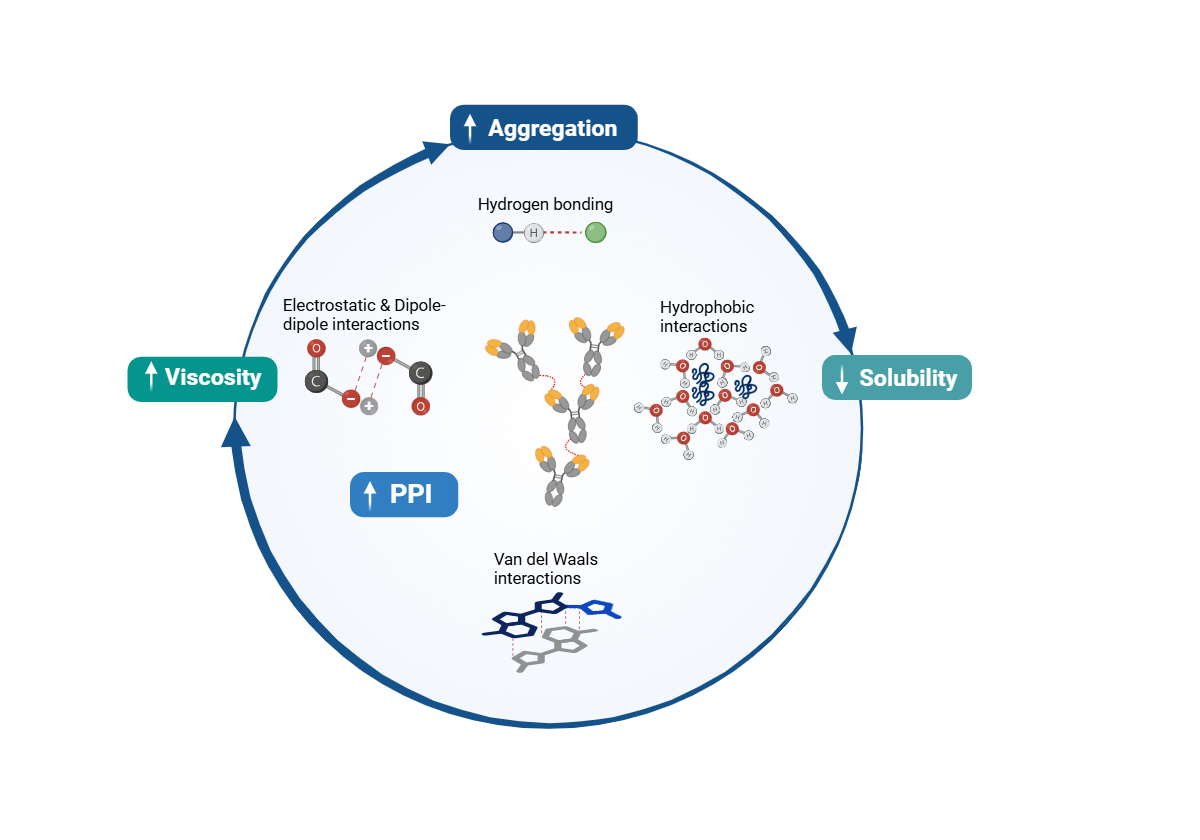
Critically, these are not isolated factors but rather reinforce each other. Increasing concentration amplifies protein–protein interactions, which in turn drives self-association, raises viscosity, and can accelerate aggregation pathways [5,6,7]. Sequence features, such as hydrophobic patches or charge distribution, can further exacerbate these effects [8,9].
The consequence is a nonlinear escalation of risk. A molecule that performs well at 20 mg/mL can become non-developable at 150 mg/mL, not because of a single parameter failure, but due to the cumulative impact of interacting constraints [10,11,12]. For CMC leaders, this has a critical implication as HCF challenges are not merely formulation problems; they represent inherent molecular liabilities that must be addressed upstream.
Beyond Formulation: The System-Level Impact on CMC
The effects of high concentration extend far beyond formulation science, influencing nearly every aspect of development and manufacturing.
Manufacturability and Process Constraints
High-viscosity formulations complicate ultrafiltration/diafiltration (UF/DF), sterile filtration, and fill–finish operations.
These challenges can reduce yields, increase processing times, and introduce variability, ultimately impacting the cost of goods and scalability [13,14].
Critical Quality Attributes (CQAs)
At high concentrations, maintaining control over aggregate levels, particle formation, and stability profiles becomes significantly more difficult. Analytical methods must be adapted or enhanced to ensure accurate characterization under crowded conditions [15,16].
Device and Delivery Limitations
High viscosity also directly impacts deliverability. Increased resistance during injection can exceed device force limits, extend injection time, and ultimately reduce patient acceptability [17,18].
These constraints introduce a new dimension: the formulation must be co-optimized with the delivery device in mind, rather than treated as an independent variable.
Traditional Solutions: Necessary but Increasingly Insufficient
Over the past decade, several strategies have been widely deployed to address HCF challenges. While effective in certain contexts, they often provide incremental improvements rather than transformative solutions.
Excipient Optimization
Formulation scientists have relied on excipients, including amino acids (e.g., arginine), salts, sugars, and, more recently, polymeric and zwitterionic systems, to reduce viscosity, stabilize proteins, and modulate intermolecular interactions [19,20,21].
Although these approaches have evolved into increasingly sophisticated combinations, their effectiveness tends to plateau at very high concentrations, where physical constraints dominate.
Hyaluronidase-Enabled Delivery
Recombinant human hyaluronidase (rHuPH20) has enabled SC administration of larger volumes (up to 10 mL or more) by temporarily modifying the extracellular matrix [22,23].
This approach has supported successful IV-to-SC transitions for several marketed biologics. However, it shifts the problem rather than eliminating it by adding formulation complexity, introducing dependency on biologic excipients, and failing to resolve intrinsic molecular liabilities.
Lyophilization
Freeze-drying remains a valuable tool for improving stability [24,25]. Yet at high target concentrations, it introduces trade-offs, including low or incomplete reconstitution, increased aggregation risks during processing, and added complexity for patient use [24].
In practice, lyophilization is often used in hybrid strategies (e.g., low-concentration drying followed by small-volume reconstitution), rather than as a standalone solution for HCF.
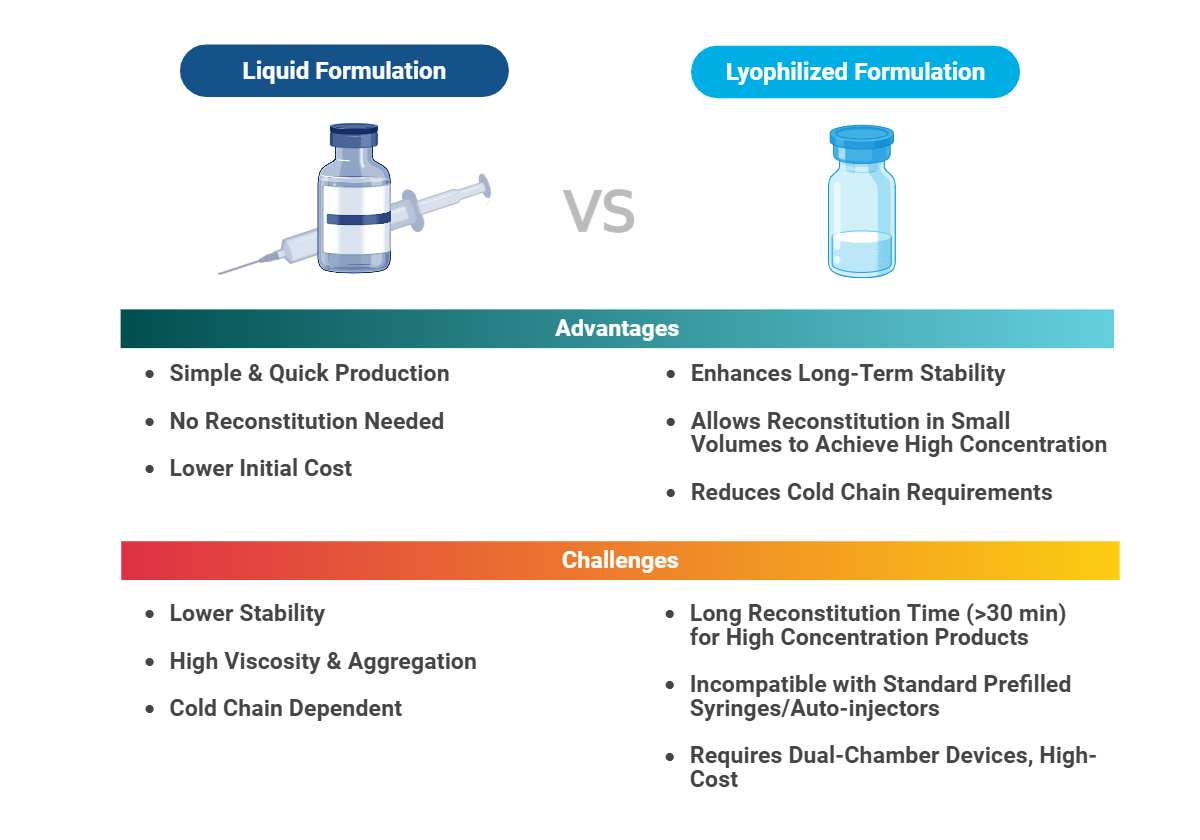

The Emerging Reality: Liquid Formulations Are Approaching Their Limits
As concentrations approach and exceed ~200 mg/mL, traditional liquid-based strategies face fundamental barriers. The issue is no longer one of optimization, but of physical feasibility [26,27]. This has catalyzed a shift in thinking. Rather than continuing to optimize crowded liquid systems, developers are increasingly exploring ways to change the physical state of the drug. A wave of emerging technologies is expanding what is possible by decoupling concentration from constraints on viscosity and stability.
Microparticle Engineering Platforms
Technologies such as spray drying, electrospray, and related approaches convert antibodies into controlled microparticles [28,29,30]. These can then be suspended in non-aqueous or minimally aqueous environments.
Key advantages:
- Enable very high effective concentrations (>300–500 mg/mL)
- Reduce viscosity by avoiding dense liquid phases
- Offer improved stability in solid or semi-solid states
Microglassification and Solid-State Systems
These approaches produce amorphous, glassy particles that improve storage stability [31,32].
Key advantages:
- Preserve protein integrity
- Enhance stability under ambient conditions
- Potentially reduce cold-chain reliance
Protein Crystallization
By organizing proteins into ordered crystalline structures, it is possible to produce a dense suspension while maintaining low viscosity and functional activity [33,34].
Key advantages:
- Achieve high-density formulations
- Maintain low apparent viscosity
- Retain functional activity
While these technologies are still maturing, they signal a clear transition: the future of high-concentration biologics lies at the intersection of formulation science and materials engineering.
For decision-makers, this introduces new evaluation criteria, including platform scalability, regulatory familiarity, integration with existing manufacturing infrastructure, and compatibility with delivery devices.
The Critical Inflection Point: Early Developability Integration
Perhaps the most important takeaway for CMC leaders is that high-concentration risks cannot be solved late.
While historically, formulation challenges were addressed during preclinical or even clinical stages, in the HCF paradigm, this approach is no longer viable. By the time viscosity or aggregation issues become evident at high concentration, molecule selection is fixed, process development is advanced, and timelines are constrained.
Late-stage mitigation often leads to reformulation delays, device redesign, and additional clinical bridging studies. To mitigate these risks, leading organizations are moving HCF considerations into discovery and early development through:
In Silico and Predictive Tools
- Machine learning models for viscosity and aggregation prediction [4,35,36].
- Structural analysis of sequence liabilities
High-Throughput Screening
- Rapid assessment of formulation conditions [37].
- Early identification of high-risk candidates
Holistic Developability Scoring
-
Integrating biophysical properties, manufacturability, and delivery feasibility
This shift requires breaking down traditional silos between discovery, formulation, process development, and device engineering. The result is a more integrated model where developability is a shared responsibility from the outset.
Device–Formulation Co-Design: A Non-Negotiable Requirement
As HCF pushes the boundaries of what is deliverable, the role of the device becomes central. Different delivery systems impose specific constraints. For example, autoinjectors have limited injection force and volume. Pre-filled syringes introduce manual variability. Wearable injectors allow for larger volumes but add complexity [38,39].
Device selection defines the feasible formulation space. A formulation that performs well in a wearable injector may fail in an autoinjector. Therefore, changing devices late in development can trigger significant delays and regulatory burden.
For this reason, drug–device co-development must begin early, with clear alignment on target product profile and patient use scenarios. Given the expanding solution landscape, selecting the right approach requires a structured framework.
Given the expanding solution landscape, selecting the right approach requires a structured framework.
- Molecule Risk Assessment
- Intrinsic viscosity and aggregation propensity
- Sequence-driven liabilities
- Target Product Profile (TPP)
- Dose requirements
- Route of administration
- Patient population and usability needs
- Strategy Tiering
- Tier 1: Excipient optimization
- Tier 2: Enabling technologies (e.g., hyaluronidase, lyophilization)
- Tier 3: Platform shift (particle engineering, crystallization)
- CMC and Commercial Readiness
- Manufacturing scalability
- Regulatory pathway clarity
- Device compatibility
- Cost and timeline implications
Outlook
For organizations evaluating external partners for antibody development, high-concentration formulation (HCF) has introduced a new and more demanding set of selection criteria. Beyond traditional capabilities, partners must demonstrate integrated expertise, with the ability to connect molecule design, formulation strategy, process development, and device considerations into a cohesive development pathway.
Equally important is early developability capability, including the use of predictive modeling, high-throughput screening platforms, and a proven track record of identifying and mitigating molecular liabilities at the earliest stages. Platform breadth has also become critical, requiring access to both established and next-generation formulation technologies, along with the flexibility to adapt strategies as program needs evolve. In parallel, regulatory and manufacturing readiness remain essential, and partners must show experience in scaling advanced formulations and a strong understanding of emerging regulatory expectations in this increasingly complex space.
Connecting discovery to development through Hu-mAtrIx™, Integrated CMC, and Toxicology
Advancing antibody therapeutics from discovery to IND requires early integration of developability, safety, and manufacturability considerations. Nona Biosciences enables this continuity through its proprietary Hu-mAtrIx™ platform, which supports the generation of highly diverse, fully human antibodies with optimized developability profiles from the outset, reducing downstream liabilities.
This foundation is complemented by Nona’s integrated Toxicology and Safety Assessment capabilities, which can evaluate immunogenicity risk, off‑target interactions, and mechanism‑related safety early during discovery. These insights inform candidate selection while aligning with regulatory expectations to support a smoother path toward clinical entry.
In parallel, Nona’s CMC platform translates selected candidates into robust, scalable biologics through comprehensive developability assessment, process development, and analytical characterization. By linking Hu-mAtrIx™-enhanced discovery with integrated toxicology and CMC workflows, Nona Biosciences delivers a cohesive strategy that de-risks development, accelerates timelines, and enables the confident progression of high‑quality antibody-based candidates into the clinic.
Related Resources
To explore Nona’s integrated capabilities supporting developability-driven antibody development in greater detail:
-
- Download our Brochure on Hu-mAtrIx™ for an overview of how our AI-powered platform accelerates fully human antibody discovery through predictive modeling, closed-loop learning, and data-driven optimization.
- View our Corporate Brochure for an overview of Nona’s integrated antibody discovery, engineering, and development capabilities.
- Berteau C. et al., 2015. [Link]
- St. Clair-Jones A. et al., 2020. [Link]
- Chowdhury A. et al., 2020. [Link]
- Yadav S. et al., 2010. [Link]
- Armstrong G.B. et al., 2024. [Link]
- Pindrus M. et al., 2015. [Link]
- Agostini F. et al., 2012. [Link]
- Wang W. et al., 2010. [Link]
- Wang W. et al., 2018. [Link]
- Moussa E.M. et al., 2016. [Link]
- Holstein M. et al., 2020. [Link]
- Shieu W. et al., 2016. [Link]
- Schofield T. et al., 2015. [Link]
- Warne N.W., 2011. [Link]
- Babaee S. et al., 2025. [Link]
- Bittner B. et al., 2026. [Link]
- Chen B. et al., 2004. [Link]
- Borwankar A.U. et al., 2016. [Link]
- Zeng Y. et al., 2021. [Link]
- Frost, G.I. 2007. [Link]
- Locke K.W. et al., 2019. [Link]
- Colandene J.D. et al., 2007. [Link]
- Kasper J.C. et al., 2013. [Link]
- Sahin E. et al., 2010. [Link]
- Heinen M. et al., 2012. [Link]
- Ameri M. et al., 2006. [Link]
- Mutukuri T.T. et al., 2021. [Link]
- Alkhatib H. et al., 2025. [Link]
- Aniket Gaut D.A. et al., 2014. [Link]
- Chandrababu K.B. et al., 2024. [Link]
- Bhami S. et al., 2001. [Link]
- Erfani A. et al., 2023. [Link]
- Lai P.K. et al., 2022. [Link]
- Rai B.K. et al., 2023. [Link]
- Chai Q. et al., 2019. [Link]
- Connor R.J. et al., 2025. [Link]
- Staples A.S.M. et al., 2025. [Link]