
How Different Bispecific ADC Designs Address Key Challenges in Breast Cancer
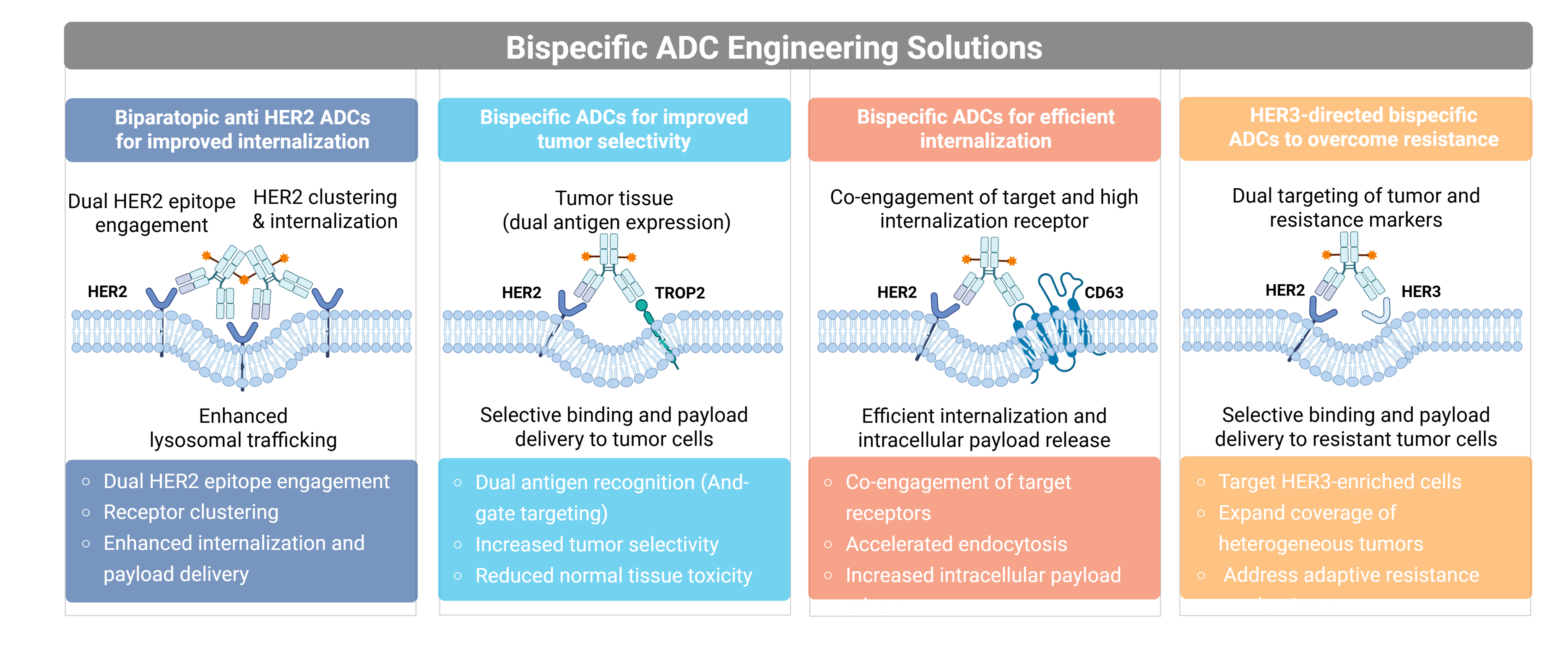
Biparatopic HER2 ADCs: Improving internalization and payload delivery
In anti-HER2 biparatopic ADCs, simultaneous engagement of two distinct HER2 epitopes promotes cooperative receptor clustering and more efficient internalization. By cross-linking HER2 molecules into larger receptor complexes, these ADCs enhance endocytic uptake and intracellular payload delivery, ultimately improving antitumor activity [2].
To date, dual-domain or biparatopic HER2-targeting strategies have been implemented in several ADC programs, including ZW49, MEDI4276, and JSKN003 [2]. Among these, clinical evaluation of MEDI4276 was discontinued due to high toxicity and specifically high incidence of interstitial lung disease, an adverse event closely monitored for HER2-targeted ADCs.
In contrast, ZW49 (NCT03821233) and JSKN003 (NCT06846437, NCT07545044, NCT06079983 and NCT05582499) have shown more manageable toxicities at the clinical stage.
Engineering challenges of biparatopic ADC design:
Translating this biological concept into a therapeutically effective ADC, however, requires careful antibody engineering. Unlike conventional ADCs, which typically employ a monospecific IgG targeting a single epitope, biparatopic ADCs must simultaneously engage two non-overlapping epitopes on the same receptor. The success of this approach depends not only on target selection but also on epitope accessibility, binding geometry, and the ability of the antibody format to promote productive receptor clustering and internalization [7, 8].
In this context, compact binding domains, particularly single-domain binders such as autonomous VH or VHH domains, may offer unique advantages. Their small size can facilitate access to sterically restricted epitopes that may be difficult to reach with conventional Fab-based antibodies or even scFv formats. Moreover, single-domain binders provide exceptional engineering flexibility, enabling the design of compact biparatopic and multispecific architectures while supporting diverse ADC configurations.
Dual-antigen targeting for improved tumor selectivity
One of the principal challenges in ADC therapy for breast cancer is the heterogeneous expression of target antigens across primary tumors and metastatic lesions. Continuous tumor evolution gives rise to genetically and phenotypically distinct cell populations that may express different levels, or even different combinations, of therapeutic targets. This complexity has fueled the development of bispecific ADCs designed to recognize dual tumor-associated antigens, thereby increasing tumor selectivity while reducing the likelihood of treatment escape driven by antigen heterogeneity [9].
Several breast cancer-relevant bispecific ADCs have been developed with the primary objective of improving tumor selectivity through dual-target recognition, including combinations targeting TROP2, HER2 and B7-H4, among others. Although none have yet reached the clinical stage in breast cancer, these programs have provided compelling preclinical evidence supporting the utility of dual-antigen targeting.
TROP2 x B7-H4 ADC:
TROP2 and B7-H4 are co-expressed in a subset of breast cancers, particularly triple-negative breast cancer (TNBC), while their combined expression appears more restricted in normal tissues. Leveraging this co-expression profile, Innovent has developed the bispecific ADC IBI3022 to simultaneously target TROP2 and B7-H4 with the goal of improving tumor specificity while reducing off-tumor toxicity associated with conventional TROP2-directed ADCs [10].
Preclinical studies demonstrated superior cytotoxicity and tumor growth inhibition relative to corresponding monospecific ADCs across multiple breast cancer models, including MDA-MB-468, HCC1806, HCC1569, and JIMT1 xenografts [10].
HER2 x TROP2 ADC:
HER2 and TROP2 are frequently co-expressed across multiple breast cancer subtypes, including HER2-low tumors. This expression pattern has prompted the development of several HER2×TROP2 bispecific ADCs, including YH012, OBI-201, and RB-201 [11, 12, 13]. Preclinical studies have shown enhanced internalization, improved tumor selectivity, and superior antitumor activity in HER2-positive and HER2-low xenograft models when compared with benchmark HER2- or TROP2-targeting ADCs alone.
Engineering challenges of dual-antigen targeting
Successfully implementing dual-antigen recognition requires more than simply combining two binders within a single molecule. The selected targets must display appropriate co-expression patterns in tumor tissues while maintaining limited overlap within healthy tissues.
In addition, the antibody components must achieve sufficient affinity, specificity, and spatial compatibility to support efficient target engagement without compromising developability or manufacturability. These challenges are increasing demand for antibody discovery platforms capable of identifying binders against highly differentiated or difficult-to-access epitopes.
Shuttle-receptor bispecific ADCs for enhanced intracellular delivery
Efficient internalization is a critical determinant of ADC efficacy, as intracellular trafficking and lysosomal processing are required for payload release. However, many clinically relevant tumor antigens exhibit relatively slow or inefficient internalization, limiting payload delivery and reducing therapeutic activity. To address this challenge, an emerging bispecific ADC strategy incorporates a second antibody arm directed against receptors with intrinsically high internalization rates and efficient trafficking to lysosomes. These so-called “shuttle receptors” may be broadly expressed or enriched in tumor tissues, where they can simultaneously enhance intracellular payload delivery and contribute to tumor selectivity.
Several bispecific ADCs targeting HER2 and highly internalizing receptors, including CD63, APLP2, or the prolactin receptor (PRLR), have been developed in the breast cancer setting.
HER2 x CD63 ADC:
CD63 is a ubiquitously expressed tetraspanin that constitutively shuttles between the cell surface and endolysosomal compartments, making it an attractive intracellular trafficking receptor. De Goeji et al. demonstrated that a bispecific HER2×CD63 ADC could exploit CD63-mediated lysosomal routing to enhance the intracellular delivery of cytotoxic payloads to HER2-positive tumor cells. In preclinical studies, the HER2×CD63 bispecific antibody promoted HER2 downregulation, increased lysosomal accumulation, and induced more potent tumor cell killing than corresponding monospecific HER2 or CD63 ADCs. Notably, the HER2×CD63 ADC produced significant antitumor activity in HER2-positive xenograft models, whereas monovalent HER2- or CD63-targeting ADCs were ineffective. These findings provided proof-of-concept that rapidly internalizing “shuttle” receptors can be leveraged to improve payload delivery to targets with suboptimal internalization characteristics, such as HER2 [14]. To date, however, no HER2×CD63 bispecific ADC program has advanced to clinical development.
HER2 x PRLR ADC:
PRLR is generally expressed at low levels in some breast tumor types. Despite its low expression, early work from Regeneron demonstrated that PRLR’s constitutive trafficking to the lysosome compensates for its low expression, enabling efficient payload shuttling and cancer cell killing preclinically both in vitro and in vivo. Moreover, bispecific ADCs targeting HER2 and PRLR showed improved cancer cell killing efficiency over either monospecific ADC [15]. To date, no bispecific ADC programs leveraging this target combination have advanced to the clinical stage. Significantly, first-in-human studies evaluating an anti-PRLR ADC candidate from Abbvie, ABBV-176, was terminated in 2018 due to safety signals [16].
Engineering challenges of shuttle-receptor targeting.
The success of this approach depends not only on target selection but also on antibody architecture. Factors such as binding valency, spatial arrangement of the targeting domains, and receptor-binding geometry can significantly influence receptor co-engagement, intracellular trafficking, and lysosomal routing [7]. Consequently, maximizing the therapeutic potential of shuttle-receptor bispecific ADCs requires careful optimization of molecular design to ensure efficient target engagement while preserving favorable pharmacological properties.
Modern multispecific engineering platforms may provide important advantages in this setting by enabling greater control over antibody architecture and target engagement. Such flexibility may help optimize receptor cross-linking, intracellular trafficking dynamics, and payload delivery efficiency, ultimately enhancing the performance of shuttle-receptor-based ADCs.
HER3-directed bispecific ADCs: A strategy to overcome treatment resistance
HER3 as a resistance-associated target:
Resistance mechanisms frequently emerge through dynamic changes in target expression and signaling networks. As a result, flexible multispecific antibody platforms may enable rapid evaluation of alternative target combinations to address evolving tumor biology and adaptive resistance mechanisms.
HER3 provides a notable example of this concept in breast cancer. HER3 is frequently overexpressed, and its upregulation is a well-established mechanism of resistance to HER2-targeted therapies. Increased HER3 signaling can restore PI3K/AKT pathway activity through HER2-HER3 heterodimerization, enabling tumor cells to evade HER2 inhibition and sustain growth [17]. Consequently, HER3 has become an attractive target for next-generation bispecific ADCs designed to simultaneously improve tumor targeting and counteract adaptive resistance pathways [18].
Consistent with this rationale, several HER3-directed bispecific ADCs have entered clinical development, while additional HER2×HER3 approaches remain in the preclinical stage.
EGFR × HER3 ADCs:
Among the most advanced examples is BL-B01D1, a first-in-class EGFR×HER3 bispecific ADC conjugated to a topoisomerase I inhibitor payload. Early clinical studies demonstrated encouraging antitumor activity across multiple breast cancer subtypes, including HER2-positive, HR+/HER2-negative, and triple-negative breast cancer, supporting the hypothesis that dual targeting of ERBB family members may overcome signaling redundancy and adaptive resistance mechanisms.
Based on promising efficacy signals, BL-B01D1 has advanced into multiple late-stage clinical studies, making it one of the most clinically mature bispecific ADCs currently being evaluated in breast cancer [19, 20, 21].
TROP2 × HER3 ADCs:
A second HER3-directed approach is represented by JSKN016, a TROP2×HER3 bispecific ADC. This design seeks to combine the broad expression of TROP2 in breast cancer with HER3-mediated resistance biology. By simultaneously targeting a lineage-associated antigen and a resistance-associated receptor, TROP2×HER3 ADCs may achieve more effective payload delivery across heterogeneous tumor populations while maintaining activity in tumors that have become dependent on HER3 signaling. Clinical development has focused primarily on HER2-negative and triple-negative breast cancer, where resistance mechanisms and intratumoral heterogeneity remain substantial therapeutic challenges. Ongoing clinical studies will help determine whether dual targeting can improve upon the efficacy observed with currently approved monospecific TROP2 ADCs [22].
HER2 × HER3 ADCs:
Direct dual targeting of HER2 and HER3 represents an especially attractive strategy given the central role of HER2-HER3 heterodimerization in breast cancer biology. Preclinical proof-of-concept was demonstrated by a novel bispecific antibody drug conjugate targeting HER2 and HER3 which exhibited greater internalization and potent antitumor activity across multiple breast cancer models. The construct significantly inhibited tumor growth in HER2-expressing xenografts and achieved efficacy comparable to the combination of separate HER2- and HER3-targeting ADCs. These findings suggest that simultaneous targeting of HER2 and HER3 may enhance both tumor selectivity and intracellular payload delivery while also addressing adaptive HER3-mediated escape signaling. However, despite the strong biological rationale, HER2×HER3 bispecific ADCs remain at the preclinical stage, with no clinical candidates yet reported [18].
